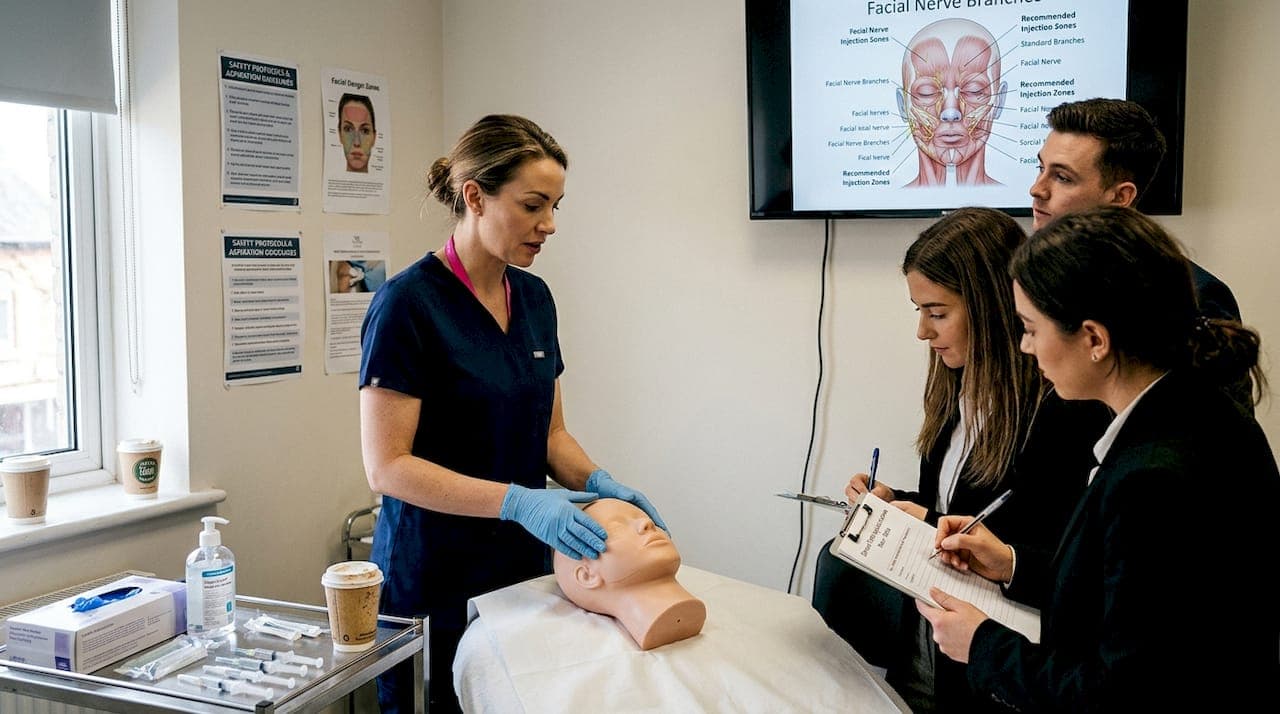
Choosing the right aesthetics training in Ireland has never felt more urgent. Current regulations allow dermal fillers to be administered by almost anyone, but that is changing fast. With new legislation on the horizon and a growing demand for skilled practitioners, the pressure to pick a course that delivers real skill, genuine compliance, and lasting career support is very real. Whether you are a medic looking to specialise or a non-medic ready to launch your aesthetics practice, this guide gives you the practical framework to make the right call.
Table of Contents
- How to evaluate aesthetics training providers
- Top tips for dermal filler training
- Advanced skincare: Training essentials and course comparison
- How complications training sets Irish practitioners apart
- Maximise your Irish aesthetics career with expert-led training
- Frequently asked questions
Key Takeaways
| Point | Details |
|---|---|
| Regulations changing soon | Ireland is set to restrict dermal fillers to trained healthcare professionals, so course selection must be future-proof. |
| Comprehensive training matters | Multiple practical days and thorough complications modules are vital for both skill and patient safety. |
| Choose accredited courses | Opt for Level 4 diplomas and accredited providers to ensure insurance cover and regulatory compliance. |
| Post-course support boosts careers | Ongoing mentorship and case study reviews help practitioners build confidence and reputation. |
How to evaluate aesthetics training providers
Not all aesthetics training is created equal. Before you commit to any course, you need a clear set of criteria to measure providers against. Here is what genuinely matters.
Regulatory status and upcoming changes
Ireland is moving towards restricting dermal filler treatments to trained healthcare professionals. Non-medics face insurance limits and incoming legislation that will reshape who can legally practise. Any training provider worth your investment should be actively preparing students for this shift, not ignoring it.
Qualifications and entry requirements
Some courses require a medical background; others are open to non-medics with a Level 4 diploma. Know which pathway applies to you before you enrol. Check that the qualification is internationally recognised and accepted by Irish insurers.
Group size, practical days, and support
Small group sizes (ideally two to six students) mean more hands-on time with live models. Look for best practices for training that include multiple practical days, not just theory. Post-course mentorship and case study review are non-negotiable if you want to build a real client portfolio.
Insurance implications
Your insurance provider will want to see your qualification certificate. Some policies exclude non-medics from certain treatments entirely. Confirm coverage before you book.
Pro Tip: Ask every provider directly whether their qualification is accepted by Irish aesthetics insurers. A great course that leaves you uninsurable is worthless.
Top tips for dermal filler training
Now let us get specific. These are the most actionable tips for choosing and completing dermal filler training in Ireland.
-
Insist on in-depth complications training. Complications can and do occur even in skilled hands. Reversal agents require prescribing power, so your trainer must be qualified to prescribe hyaluronidase or have a prescribing partner on hand. If a course skips this, walk away.
-
Prioritise small group sizes. You learn by doing. A class of twenty students sharing one model is not training; it is observation. Aim for courses with no more than six students per session.
-
Avoid one-day courses. Single-day courses have been widely criticised as insufficient for mastering both technique and safety. You need multiple practical sessions to build genuine confidence.
-
Check the trainer's prescribing credentials. If something goes wrong during a training session, your trainer needs to be able to act immediately. Confirm this before you book.
-
Look for post-course case study review. The learning does not stop when the course ends. Providers who review your case studies after graduation help you refine your technique and catch errors before they become habits.
-
Read real student experiences. Browse student reviews and check the course gallery to see real results from real graduates. This tells you far more than a brochure ever will.
Pro Tip: When you enrol on Irish courses, ask for a breakdown of how many hours are spent on live model practice versus theory. The ratio reveals everything about a course's real-world value.
Advanced skincare: Training essentials and course comparison
Dermal fillers are just one part of a thriving aesthetics practice. Advanced skincare treatments are in high demand across Ireland, and the right diploma opens doors to a much broader client base.
What a Level 4 diploma covers
A VTCT or ITEC Level 4 diploma is the benchmark qualification for advanced skincare in Ireland. It typically covers laser and IPL treatments, plasma pen, chemical peels, mesotherapy, and skin boosters. The nappage technique is used specifically in mesotherapy and skin booster treatments for improved uniformity and safety.

Course comparison: What to look for
| Feature | Minimum standard | Best-in-class |
|---|---|---|
| Practical days | 2 days | 3 or more days |
| Case study requirement | 5 clients | 10 or more clients |
| Techniques covered | Peels only | Laser, IPL, plasma pen, peels, mesotherapy |
| Post-course support | None | Ongoing mentorship |
| Cost (mesotherapy, 2-day) | €2,200 | Varies by provider |
Key techniques to look for
- Laser and IPL for skin rejuvenation and hair removal
- Plasma pen for skin tightening and resurfacing
- Chemical peels using low molecular weight hyaluronic acid (LMWHA) for deeper penetration
- Mesotherapy using the nappage microinjection method
- Skin boosters for hydration and collagen stimulation
Explore Irish aesthetics courses that cover all of these techniques under one diploma. The more treatments you can offer, the stronger your earning potential from day one. Check the ongoing support available after you qualify, because continued guidance is what separates confident practitioners from anxious ones.
How complications training sets Irish practitioners apart
Complications training is not a nice-to-have. In 2026, it is the single biggest differentiator between practitioners who build lasting reputations and those who do not.
The real risks of dermal fillers
Even experienced practitioners encounter complications. The most serious include vascular occlusion leading to necrosis, vision loss or blindness from arterial injection, product migration, and the Tyndall effect (a bluish discolouration from superficial filler placement). These are not rare edge cases; they are documented outcomes that require immediate, skilled intervention.
Why prescribing power matters
Hyaluronidase, the enzyme used to dissolve hyaluronic acid filler in an emergency, is a prescription-only medicine in Ireland. Complications occur even for skilled practitioners, and the government has pledged to regulate the industry accordingly. If your trainer cannot prescribe or does not have a prescribing partner present, you are training without a safety net.
"The ability to recognise and manage complications is not optional. It is the foundation of ethical aesthetics practice."
Comparing complications training quality
| Training feature | Basic course | Comprehensive course |
|---|---|---|
| Vascular occlusion protocol | Not covered | Fully covered |
| Hyaluronidase access | Not available | Prescriber on site |
| Safe zone anatomy | Brief overview | Detailed, practical |
| Cannula training | Not included | Included |
| Post-course mentorship | None | Lifetime support |
Cannula training reduces the risk of vascular injury significantly compared to sharp needle techniques. Safe zone anatomy teaches you which facial areas carry the highest risk and how to avoid them. These are skills you build over time, which is why support after training from a qualified mentor is so valuable.
Maximise your Irish aesthetics career with expert-led training
You now know what separates excellent aesthetics training from average. The next step is finding a provider in Ireland that actually delivers on every point: small groups, live model practice, complications training, prescriber access, and genuine post-course support.
At Pro Training Aesthetics Academy, we offer one-to-one, personalised training across Ireland for both medics and non-medics. Every programme includes hands-on sessions with live models, full complications training, and lifetime mentorship so you are never left to figure things out alone. Read what our graduates say on our student testimonials page, browse real results in our course photos gallery, and when you are ready, book your training with a team that is fully invested in your success from day one.
Frequently asked questions
Do I need formal qualifications for dermal fillers in Ireland?
Upcoming regulation will restrict dermal filler treatments to trained healthcare professionals, so while anyone can currently administer them, this is set to change soon. Investing in accredited training now puts you ahead of the legislation.
How long should an aesthetics training course last for best results?
Experts recommend multiple practical days and completed case studies as a minimum; single-day courses are widely considered insufficient, with a Level 4 diploma typically requiring at least three practical days. The more hands-on time you get, the more confident and competent you will be.
What is the nappage method in mesotherapy courses?
Nappage is a microinjection technique used in mesotherapy and skin booster treatments that delivers product in small, rapid injections across the treatment area for better uniformity. It is a core skill in any quality advanced skincare diploma.
Why is complications training important for aesthetics practice?
Complications can affect even the most skilled practitioners, and knowing how to respond to issues like necrosis or vascular occlusion is essential for both client safety and your professional reputation. Without this training, you are not fully prepared to practise ethically or safely.